We use cookies to make your experience better. To comply with the new e-Privacy directive, we need to ask for your consent to set the cookies. Learn more.

The Great Northern Railway maintained an independent existence for 77 years, much of that time prosperously established as the second largest and certainly most enterprising of the Irish railways.
Springing from the need to link Dublin and Belfast by rail it was the result of amalgamation of numerous smaller companies. Perhaps because no gathering of company promoters could be assembled who would agree on such a far-sighted railway policy, the Dublin-Belfast link was forged piecemeal. Rail access to Londonderry was similarly done in stages. Between these routes, the Ulster Railway had reached Clones.
Secondary and branch lines were supplementing these main routes. The political and technical changes which followed World War I produced a rapid change in fortunes: the political division of Ireland, civil war, tariff restrictions, and above all the development of road transport, all reacted against the GNR(I). Falling receipts and soaring operating costs brought the company to its knees shortly after the end of World War II. Five years of shared nationalisation followed, during which much of the system suffered closures. In 1958 what was left was divided and administered thereafter by the Ulster Transport Authority and by Coras Iompair Eireann.
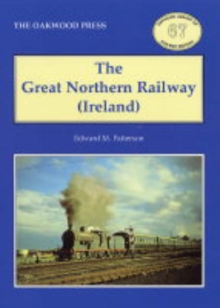
First published in 1962, in this new edition, Dr Patterson's text remains largely unaltered, except where more recent research has revealed new data. Presented in an A5 format, this book consists of 240 pages, 190 illustrations, with a full colour laminated card cover with a square-backed spine.
| ISBN/EAN | 9780853616023 |
|---|---|
| Author | Edward Mervyn Patterson |
| Publisher | Stenlake |
| Publication date | 20 Mar 2009 |
| Format | Paperback |
Write Your Own Review
The Great Northern Railway (Ireland)
The Great Northern Railway maintained an independent existence for 77 years, much of that time prosperously established as the second largest and certainly most enterprising of the Irish railways.
Estimated delivery in 1-5 working days
Read more about our shipping and delivery